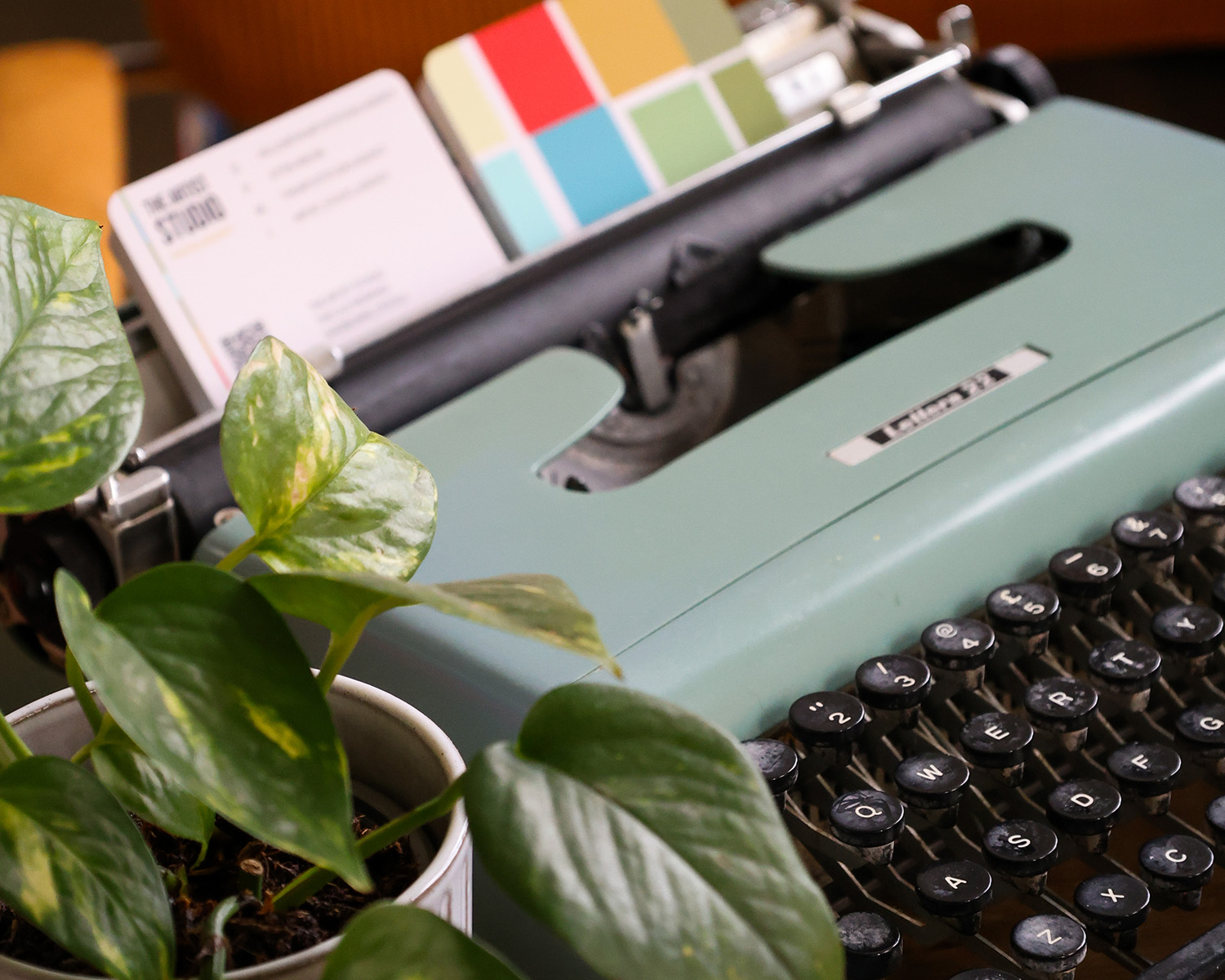
Dorset has one of the densest creative communities in the country relative to its size. Dorset Art Weeks alone opened 294 venues across the county in 2026, and the digital and creative sector accounts for around 20,000 jobs and £823 million to the local economy. For a rural county of roughly 780,000 people, that’s a lot of people making things.
We run a design studio on South Street in Sherborne, so we’re hardly neutral on this. But the case for Dorset as a creative place doesn’t rest on atmosphere or nice light over the Blackmore Vale. It rests on infrastructure, and on a few hundred people who decided to build things here rather than in London.
What is Dorset Art Weeks?
Dorset Art Weeks [DAW] is the county’s open studios event, run by the charity Dorset Visual Arts, where artists and makers open their working spaces to the public for a fortnight. The 2026 edition ran from 23 May to 7 June across 294 venues, from town-centre galleries to studios down farm tracks. Most were free to visit.
The significant thing about 2026 isn’t the scale, it’s the frequency. After years as a biennial event, DAW has moved to an annual format. That sounds like a scheduling footnote. It isn’t. A biennial event is a showcase. An annual one is a rhythm, and rhythm is what turns a scattering of individual practices into something that behaves like a scene. It also gives makers a reliable date to build a year’s work towards, which matters more than it sounds when you’re self-employed and your studio is a converted barn outside Beaminster.
Open studios work because of what they show. You see the half-finished piece, the wall of test prints, the tools. We spend our working lives on the polished end of that process, photographing finished products and building the sites they sell on, and it’s a useful corrective to be reminded how much mess sits behind a clean final image.
What makes Sherborne a creative town?
Sherborne has an unusual concentration of arts venues for a market town of 10,000 people. The Sherborne, a restored Georgian house on Newland, now operates as a gallery, sculpture park and events venue, and has become the home venue for Dorset Visual Arts. St Michael’s Studios houses a cluster of working artists in the centre of town. The Jerram Gallery and Swan Gallery both sit within a few minutes’ walk.
Then there’s Studio Sherborne, set up by the artist Victoria Young-Jamieson in a restored warehouse building, which runs workshops and exhibitions and functions as a meeting point as much as a gallery. Add the Sherborne Abbey Festival each spring and the Literary Society’s programme through the year, and a town this size ends up with more going on than places ten times bigger.
What The Sherborne has done is worth paying attention to. Taking a listed building that had been drifting for years and turning it into a functioning cultural venue with a gallery, a kitchen and a public programme is difficult, expensive work. Dorset Visual Arts revived its Making Dorset exhibition there, showing work from more than 30 makers including furniture makers of the standing of John Makepeace and Petter Southall. That’s a serious craft roster by any standard, and it’s ten minutes from our front door.
Where else in Dorset is worth knowing about?
West Dorset carries the heaviest concentration of individual studios, particularly in the lanes around Bridport and Lyme Regis. Portland has b-side, which makes ambitious, site-specific work about the island and its folklore. Shaftesbury runs a grassroots Fringe. Sandy Hill Arts near Charmouth operates as a working creative hub rather than a gallery. Camp Bestival brings around 30,000 people to Lulworth each summer.
At the other end of the county, Bournemouth and Poole hold the digital half of the creative economy: visual effects, games, animation, post-production. Bournemouth University’s National Centre for Computer Animation has been running since 1989 and is one of the reasons the region has a genuine animation and VFX cluster rather than a handful of freelancers.
Those two worlds don’t overlap as much as they could. A ceramicist in Bridport and a VFX studio in Bournemouth are both in Dorset’s creative economy on paper, and rarely in the same room in practice.
Is Dorset actually a good place to build a creative business?
Yes, with a caveat worth stating plainly. The advantages are real: lower overheads than any city, clients who value craft, and a network of makers and small brands that generates work for each other. Most of our clients are independent Dorset and Somerset brands, and a good proportion arrived through someone else we’d worked with.
The caveat comes from the county’s own culture sector impact report, which found that the number of new and emerging creatives in Dorset is low. Nationally, just over half the creative workforce comes from advantaged backgrounds, around 7% higher than the UK average across all jobs. Rural creative economies have an access problem. If you need a studio, a car, and a period of low earnings to establish yourself, the people who can afford that are a narrow group. Dorset’s scene is strong at the established end and thin at the entry end.
That’s a solvable problem, and some of the solutions already exist here: affordable studio space, workshops that aren’t priced as luxury experiences, and open studios that let people see the work being made rather than only the finished object in a gallery. Worth supporting if you’re in a position to.
Why we work here
We could run this studio from anywhere. Most of what we do arrives as files. We stayed in Sherborne because proximity to the people we work for turns out to matter more than we expected.
When we photograph a candle for Compton Candle Co. or build a site for Shirley’s Cider, we’ve usually been to the place where the thing is made. You end up with a better result, and you end up with a different relationship, because you’ll see them at the market on Saturday. That’s not a business strategy anyone would design on purpose. It’s just what happens when you work where you live, and it produces noticeably better work than briefing calls with someone two hundred miles away.
Dorset has a long habit of people making things properly and not making much noise about it. We like that. It’s a reasonable model for running a studio, too.
Answered questions
When is Dorset Art Weeks?
Dorset Art Weeks ran from 23 May to 7 June in 2026 and is now an annual event, having previously been biennial. It usually takes place in late May and early June. Details and venue listings are published at dorsetartweeks.co.uk, with a printed guide distributed across the county from mid-April.
How many venues take part in Dorset Art Weeks?
The 2026 event featured 294 venues across Dorset, including artists’ open studios, workshops, group shows and exhibitions. This was up from 266 venues at the previous event. Most venues are free to visit.
Who runs Dorset Art Weeks?
Dorset Visual Arts, a registered charity with more than 250 members that promotes artists and makers across the county. Its home venue is The Sherborne, the restored Georgian house on Newland in Sherborne.
Is Dorset a good place to live if you work in a creative industry?
For established practitioners, yes. Overheads are far lower than in a city, the maker community is dense and well connected, and clients tend to value craft. The main difficulty is at the entry level, where the cost of studio space and transport makes it harder to establish yourself than in a city with more shared infrastructure.
What creative businesses are based in Sherborne?
Sherborne supports an unusually high number for a town of its size, including The Sherborne arts venue, St Michael’s Studios, Studio Sherborne, the Jerram Gallery and the Swan Gallery, alongside independent design and photography studios. Dorset Visual Arts is also based in the town.
The Artist Studio is a design and photography studio on South Street in Sherborne, working with independent brands across Dorset and Somerset. If you’re a Dorset maker with something worth photographing properly, come and talk to us.
Looking for a creative partner for your business? Explore our marketing and creative services in Dorset, from brand identity to websites and content.




.jpg)